Chernobyl: 40 Years
Updated: Apr 15

Forty years after the Chernobyl disaster, these photographs, taken in 2010 and 2012, capture a place that, to me, felt firmly anchored in the past. I exhibited some of these images in Melbourne in late 2012, at a time when global tensions felt comparatively lower. Despite the wars in Iraq and Afghanistan and the aftermath of the Global Financial Crisis, there remained a fragile sense that conditions were gradually improving. Even the Fukushima nuclear disaster, which occurred between my visits, was widely understood as the result of an extraordinary natural event, triggered by earthquake and tsunami, rather than a direct consequence of human conflict or intent.
Visiting the Chernobyl Exclusion Zone back then felt like observing the aftermath of a contained failure, one that had, ostensibly, led to stronger safeguards and a more cautious future for nuclear energy. It was a place that could be carefully accessed, documented, and interpreted against the backdrop of a more stable world. That sense of hindsight and stability has since unravelled.
The ongoing Russia–Ukraine war has made the zone largely inaccessible, returning instability to a landscape once cautiously reopened. Although Ukrainian forces have since regained control, what was once a site of controlled exploration is now shaped by active conflict. Photographing it has shifted from physical immersion to a more distant practice, defined by risk and geopolitical tension. For those drawn to ruins, the focus has deepened - no longer just on abandoned places, but on the fragile conditions that create them.
This change is not isolated. Global conditions, particularly in the Middle East, have become increasingly volatile, at times edging toward catastrophic escalation. In this context, these photographs no longer function solely as records of a past disaster that we can learn from. They stand instead as reminders that progress is neither linear nor guaranteed, and that the lessons of Chernobyl were never absorbed. This is underscored by the 2022 shelling around the Zaporizhzhia Nuclear Power Plant, and by renewed concerns that regional conflicts in the Middle East could damage nuclear infrastructure elsewhere, including Iran. The possibility that nuclear risk might again emerge, not from accident, but from human intent or miscalculation, feels far less hypothetical than it once did.

War in the Shadow of Reactors.
In 2022, during the Russian invasion of Ukraine, forces occupied the Chernobyl Exclusion Zone. Heavy military equipment disturbed contaminated soil, and troops reportedly dug trenches in irradiated areas, an action that would have once seemed unthinkable.
More alarmingly, the Zaporizhzhia Nuclear Power Plant, Europe’s largest nuclear facility, became an active war zone. Shelling in and around the plant raised a possibility long considered implausible: a nuclear disaster not born of technical failure, but of conflict.

Decades ago, the idea that a nuclear facility could be caught in crossfire would have seemed absurd. Now, it is precedent.
For a modern ruins photographer drawn, in part, to abandoned spaces shaped by the consequences of our practices and misjudgements, this 40th anniversary carries a particular weight - one defined not only by the memory of a past catastrophe, but by the very real risk of repeating it.

What the dilapidated interiors and overgrown spaces now say...
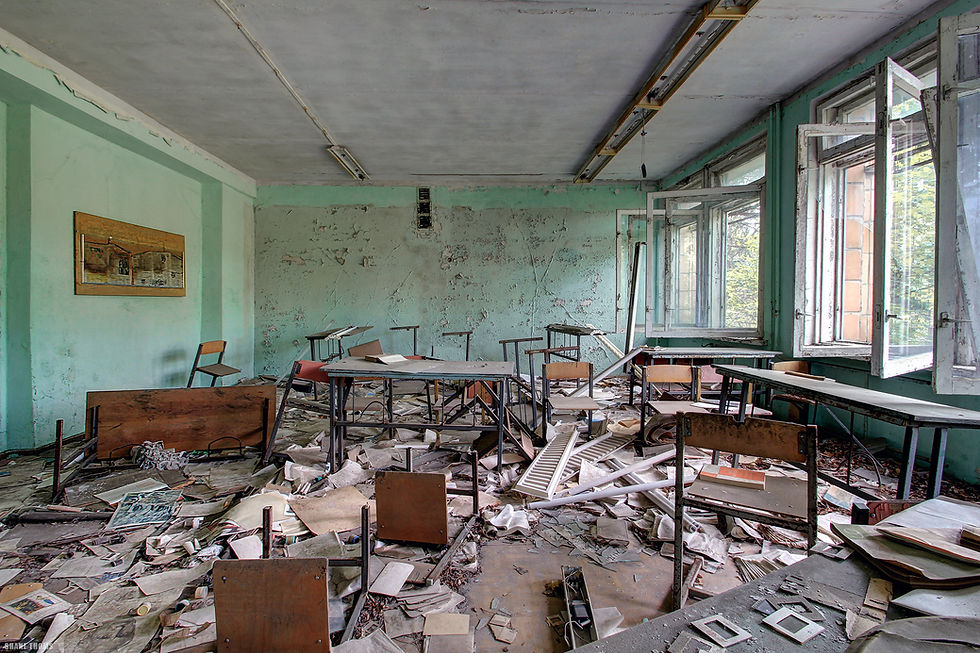
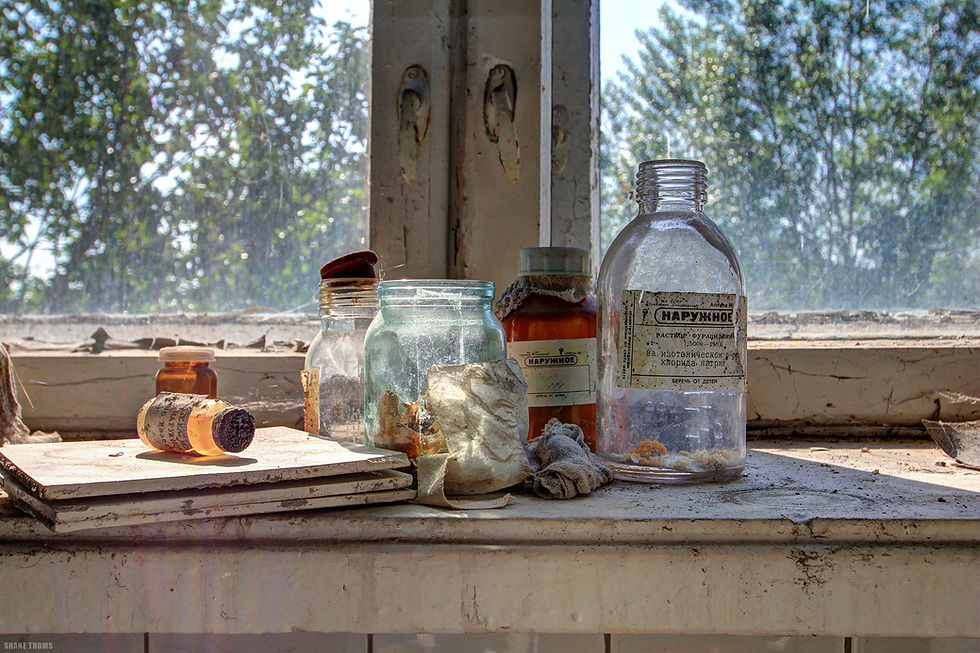
Looking back at these photographs, especially those taken in the schools and kindergartens, they read differently now.
At the time, they felt like artefacts of a closed chapter. Now, they are stern warnings.
The small desks.
The faded murals.
The gas masks sized for children.
They no longer document what catastrophically occurred on 26 April 1986, and now depict what perhaps lies ahead.






Comments